


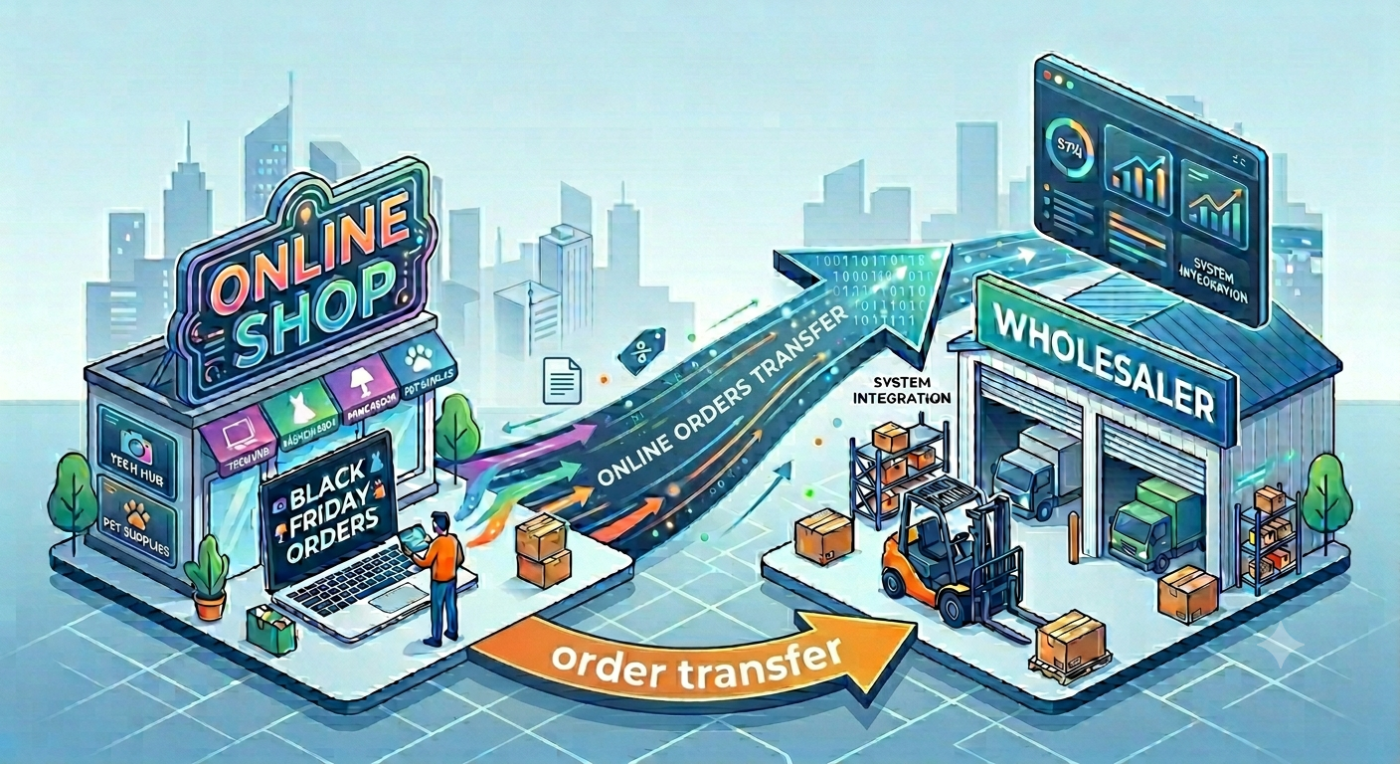
Other Black Friday guides will tell you about discounts, banners and stockpiling packaging. That matters, but order fulfilment rarely breaks where you can see it. It breaks quietly – at the point where your orders get passed to your suppliers. This article shows you where things really get tight during the peak, and how automatic order transfer keeps your fulfilment time short when order volume climbs several times over.
The peak doesn’t create new problems – it exposes old ones
At 30 orders a day, manual processing "kind of works". Your operator opens the supplier panel, re-keys the order, places it with the supplier. A bit of time, a bit of attention – it’s doable.
Then Black Friday arrives and in a single day you take as many orders as you’d normally see in a week. Suddenly the same manual process that "worked" starts to pile up. It isn’t a question of willingness or how committed your team is – it’s plain arithmetic. There’s simply several times more of the same work, and a day still has the same number of hours.
That’s why the tightest bottleneck during the peak often isn’t your website traffic or your server. It’s what happens after the order is placed – passing it to the supplier so picking and shipping can begin.
Where order processing actually breaks: manually re-keying orders to suppliers
Look at what manually transferring a single order involves. Your operator copies the products and their variants, re-types the customer’s address, checks the quantities, then places the order in the supplier’s panel. One order, one panel – that’s nothing yet.
The problem starts at scale and with several suppliers. Your operator juggles several panels at once, switches between tabs, keeps track of what’s already been re-keyed and what hasn’t. Under peak pressure it falls apart: a typo creeps into an address, a quantity gets mixed up, some orders end up "for later" – and "later" on Black Friday often means "too late".
Every such error isn’t just lost time. It’s contact with the customer, a correction, sometimes a return or an exchange – exactly when your team is already stretched.
Let’s do the maths: what manual processing really costs
"It saves you time" is a platitude. Let’s put in the numbers to see the real cost.
Manually re-keying a single order from your shop panel into a supplier panel takes around 2-5 minutes – products, variants, address, verification. Let’s take a conservative 3 minutes. The full employer cost of an e-commerce order processing specialist in the UK today is around £15 per hour.
Here’s what that means in practice:
- 50 orders a day – that’s about 2.5 hours of work every day, roughly £37.50 a day, around £825 a month just on re-keying.
- 200 orders a day – that’s already about 10 hours of work a day, around £150 a day and nearly £3,300 a month. In other words: almost a full headcount dedicated purely to re-keying orders.
Plug in your own volume – the calculation is simple: number of orders × 3 minutes × hourly rate. The closer you get to the peak, the more those minutes hurt, because all the orders land at once.
On top of that come errors. It’s commonly accepted that 1-5% of orders contain a mistake – a wrong address, a wrong quantity, a typo. Each error costs you: time to contact the customer and fix the order, often a re-shipment or a returned parcel, and in the worse cases lost goods or a customer who doesn’t come back. It’s usually tens of pounds and up – and during the peak there’s also the missed delivery deadline. As volume grows, both the number of orders and the share of mistakes made in a hurry go up.
If you’d like to work this out for your own shop, we go into it in a separate piece: how much manual order entry really costs you.
How automatic order transfer works
The mechanism is simple. The customer places and pays for an order in your shop, and the integrator automatically passes it to the right supplier – with no manual re-keying. Your operator doesn’t copy data, doesn’t switch panels, doesn’t keep track of what’s already been sent.
That immediately removes a whole class of errors: typos in addresses, wrong quantities, orders left "for later" that slip through the cracks. And most importantly in the context of the peak – it lets you handle more orders without growing your team. The number of orders rises, but the work of passing them on doesn’t – because a machine does it, not a person.
What about a basket from several suppliers? It’s a common, tricky scenario: a customer drops three products from three different suppliers into one basket. Done manually, that means splitting the basket, placing three separate orders with three suppliers and tracking each parcel individually – triple the work and triple the risk of a slip-up. The integrator does it for you: it splits the order into sub-deliveries, routes each part to the right supplier and assigns a separate tracking number for each parcel. How the customer sees such an order – as one shipment with several parcels or as separate notifications – depends on your shop’s configuration.
If you’d like to understand the mechanism in more depth, we cover it more fully in the article on automatic order transfer as a must-have in modern e-commerce.
Faster delivery doesn’t start with the courier
Many of the sellers we work with say the same thing: delivery time to the end customer is one of their top priorities and a genuine competitive edge. It’s easy to forget, though, where that time actually starts.
Not with the courier. The clock starts the moment the order reaches the supplier – because only then does the supplier begin picking and packing. If your orders don’t reach the supplier straight away – because they’re waiting for someone to re-key them by hand, or they go out in a single daily batch – that first leg takes hours, sometimes a whole day. Picking at the supplier starts that much later, and the customer waits.
Automatic transfer shortens that first leg from hours to seconds. The order is with the supplier practically the moment it’s paid for – and it’s right there, at the very start of the chain, that you win or lose a day of delivery.
Do it now, don’t wait for Black Friday
There’s one more thing worth thinking about ahead of time: when to put the automation in place. The peak is the worst possible moment to learn a new tool. The integration is best set up and tested during a quiet stretch, so that on Black Friday it simply works.
Before the season starts, it’s worth:
- deciding which suppliers to connect first,
- checking the product mapping between your shop and your suppliers,
- running a few test orders through the system and seeing how they go.
That way you go into the peak with a process that’s already proven – rather than an experiment on the busiest day of the year.
Summary
Black Friday doesn’t create new problems in order processing. It exposes the ones that, at normal traffic, you could "work around" by hand. The bottleneck is most often re-keying orders to suppliers – costly, error-prone and a drag on delivery time. Automatic transfer removes that bottleneck: orders reach the right suppliers on their own, baskets from several suppliers split into sub-deliveries, and delivery starts sooner because it begins the moment the order is paid for.
If you want to go into the peak calmly, take a look at our automatic order transfer service and get in touch before the season starts – so that everything is ready and tested well in advance.