


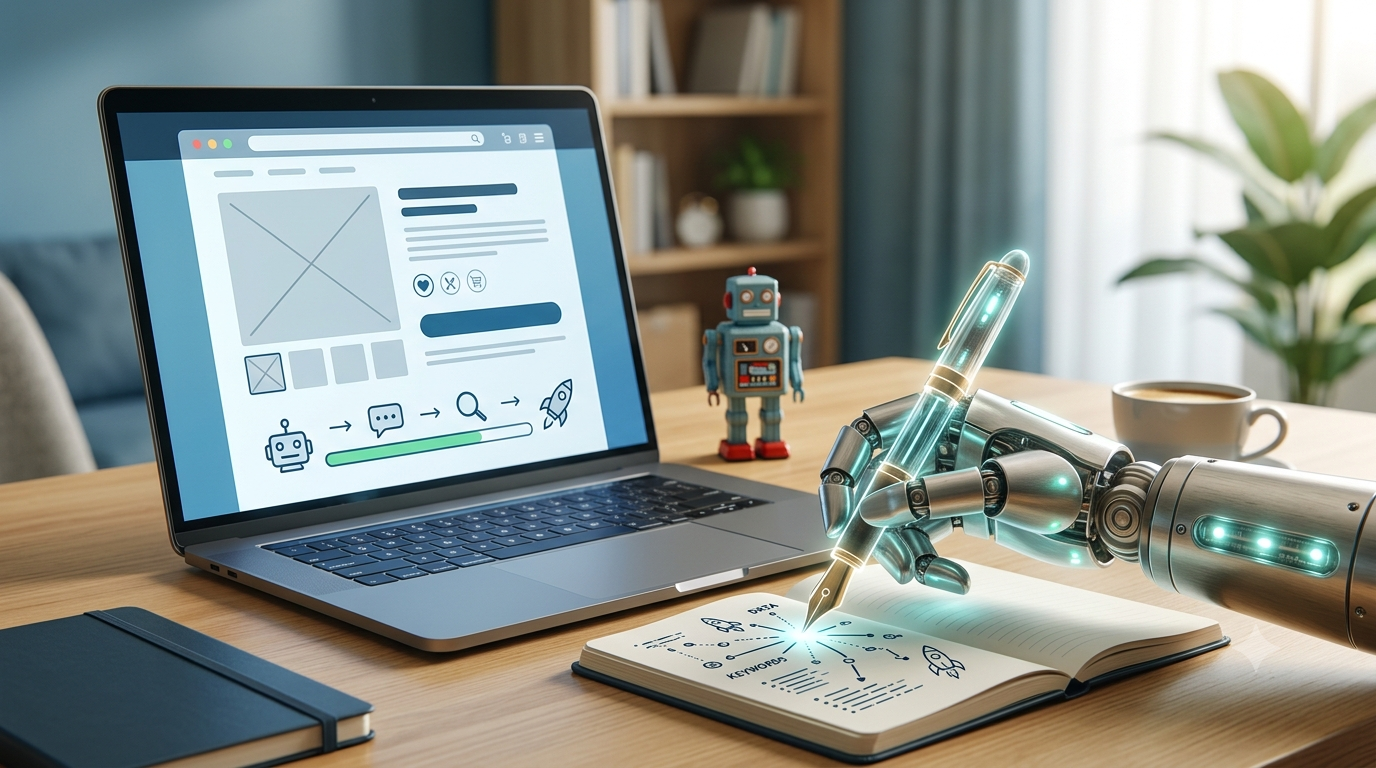
Short answer: yes, they can be. Google doesn’t penalise content just because AI helped write it – what counts is its quality and uniqueness. In this article we’ll show where the real SEO risk lies (especially in dropshipping) and how to create AI descriptions that help rather than hurt.
Short answer: yes, with one condition
AI-generated product descriptions can be good for SEO if they are unique, based on real product data and useful to the reader. The tool itself is never the problem. The problem is content that adds nothing or repeats word for word across hundreds of other pages.
That distinction matters, because a lot of fear has built up around the topic. "Will Google penalise me for using AI?" is a question almost every store asks when it considers automating descriptions. The answer: what counts is quality and uniqueness, not whether the text was written by hand or with AI.
And in dropshipping, the real SEO risk has a specific source – and it isn’t AI.
Where duplicate content comes from in a dropshipping store
As a supplier integrator, we see it up close: the product description you get in a supplier’s feed is ready-made – and identical for every store that sells the same item. You paste it in as-is, and so do dozens of other sellers alongside you.
To a search engine, that description is a duplicate. Google usually doesn’t penalise this outright – instead it picks one version of the content (the canonical one) and shows it in the results while ignoring the rest. In practice, your page may be the one left out, because it doesn’t stand out in any way. This isn’t AI’s fault – it’s the fault of copying the feed without changing anything.
And here’s the crux: since the supplier’s description has to be rewritten to be unique anyway, AI is the way to do it at scale. Not a threat, but a solution.
What Google really thinks about AI-generated content
Google’s position comes down to value for the user. It’s not about how the content was produced, but whether it answers the need of the person who lands on the page. Helpful, complete and relevant content does well – regardless of whether a human wrote it or AI did with human help.
The line is drawn elsewhere: mass-producing pages with no value, purely to manipulate rankings, breaks Google’s rules. So what matters is intent and quality, not the mere use of AI.
In practice, for a product description this means a few things: it should be unique, it should genuinely describe the product (features, use, what the buyer is looking for), and it should be readable. A description stitched together from platitudes that fits any product is weak – no matter who wrote it.
How to make AI descriptions that help SEO (instead of hurting it)
A good AI description doesn’t come "out of thin air". It comes from specific data and rules. That’s exactly how we designed our description generator – the description is built from four elements:
- Product data from the supplier – features, attributes, source description, category. This is the foundation that keeps the description truthful rather than made up.
- Category context from you – what the customer looks for in a given product group, what they pay attention to. This is what sets the description apart from generic text produced by a general model.
- SEO rules – phrases, headings and structure woven in naturally, without keyword stuffing.
- An HTML template filled with individual data from each product’s context – a consistent structure, but unique content in every description.
The result: descriptions have a repeatable, readable layout while differing in content product by product. That is exactly the uniqueness a search engine is looking for.
Scale: thousands of products, not ten
If you had ten products in your store, you could write ten descriptions by hand. But dropshipping means hundreds or thousands of SKUs from suppliers – and they keep changing. Writing unique descriptions for that many products by hand is simply not feasible.
This is where AI shows its real value. From the same supplier feed that everyone receives, you generate your own unique descriptions in your store. One import, your own descriptions – instead of a pasted duplicate you share with the competition. That’s exactly what we do as an integrator: generating AI product descriptions is part of our offer.
Quality control: a human decides what goes into the store
Automation doesn’t mean "set it and forget it". In our approach, an AI-generated description doesn’t land in the store blindly. The operator stays in control: they can edit it, approve it, or send it back to be regenerated with their own comment.
This gives you confidence that what reaches the store is correct and unique. AI does the heavy lifting at scale, while a human watches over quality at the end. That combination – automation plus human approval – is what a plain "generate text" tool doesn’t give you.
Summary
AI-generated product descriptions are good for SEO when they are unique, based on real data and checked before publication. In dropshipping, they are above all a way out of the duplicate trap – the same supplier description you share with dozens of other stores.
If you manage a large number of products from suppliers and want descriptions that are unique rather than pasted from a feed – explore our AI product description service or get in touch. We’ll show you how it works for your catalogue.