


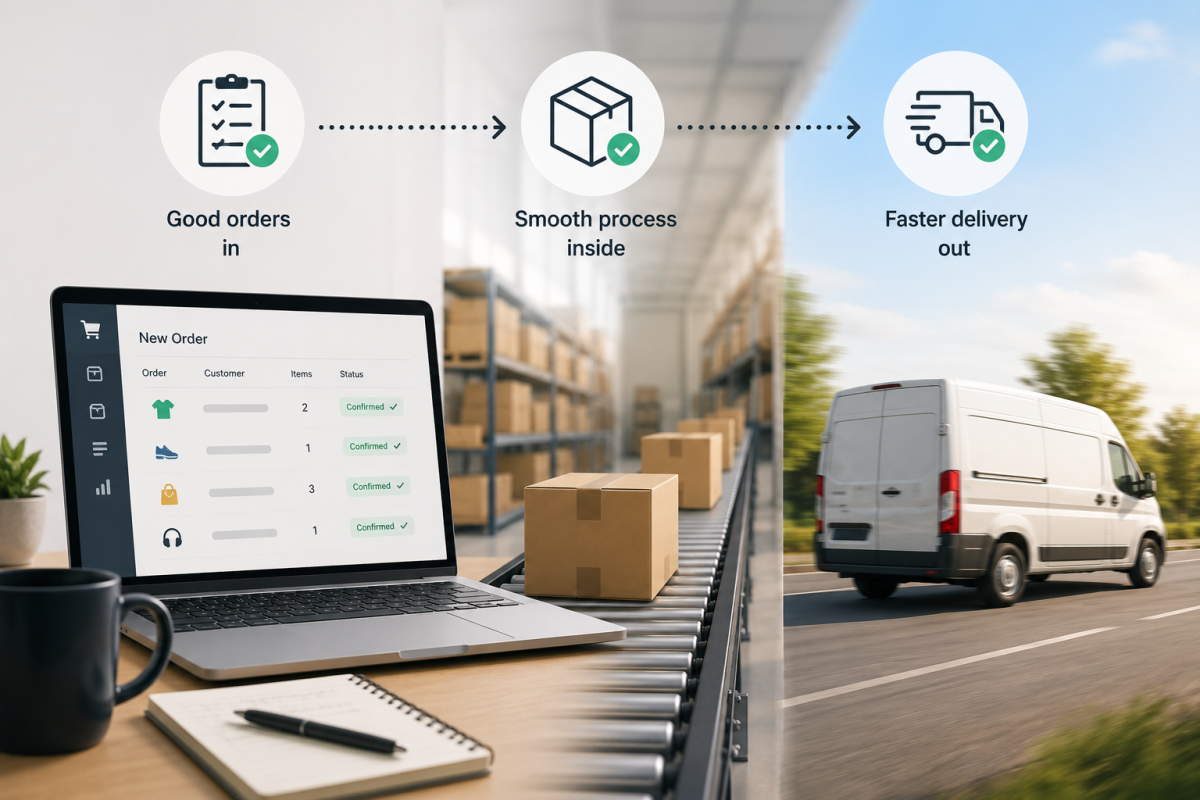
Faster delivery doesn’t start with the courier – start with your orders
When you want to shorten delivery time in your online store, the first things that come to mind are the courier, the warehouse and packing. That’s natural – because that’s what you see. But in dropshipping, a lot of time is lost much earlier: before your supplier even sees the order. In this article we’ll show you where you really lose hours, and how a fast order transfer to your supplier shortens delivery before the courier even enters the game.
Delivery time isn’t just the courier – what it’s really made of
The delivery time your customer sees isn’t a single moment. It’s the sum of several stages:
- The customer places an order in your store.
- The order reaches the supplier (wholesaler).
- The supplier picks and packs the products.
- The parcel is dispatched.
- The courier delivers it to the customer.
Most online guides focus on the end of that list – choosing a courier, warehouse layout, faster packing. That matters, but those are stages that either depend on someone else (the courier, the supplier) or apply to stores that hold their own stock on the shelf.
In dropshipping it’s different. Here the first real stage is passing the order to the supplier – and that’s exactly the stage most often left out of the conversation about delivery time.
The first stage nobody talks about: before your supplier even sees the order
In a dropshipping model, fulfillment doesn’t start until the order reaches the supplier. It sounds obvious, but it has a concrete consequence: every hour you delay passing the order on is an hour later that picking and shipping start on the supplier’s side.
Most importantly: this stage is entirely on your side. It doesn’t depend on the courier or on the supplier’s warehouse. It depends on how fast the order moves from your store into the supplier’s panel.
In conversations with clients, we see that delivery time is one of their priorities – something they compete on. And if that’s the case, it’s worth starting with the stage you actually control, instead of the one you have the least influence over.
Manual order transfer: where the time goes (and how much)
The most common scenario looks like this: an operator opens the store panel, copies the order details and pastes them into the supplier’s panel. Product by product, address, variant, quantity.
How long does it take? Re-entering a single order usually takes a few minutes. That seems like little, but the problem isn’t in the single order – it’s in two things:
- The "once a day" model. If you re-enter orders in a batch once a day, an order placed in the morning waits until the evening before it even reaches the supplier. The customer has already paid, and the supplier still doesn’t have it.
- Sales peaks. During Black Friday or before the holidays the number of orders grows, but the day still has the same number of hours. Manual re-entry becomes a bottleneck exactly when fast shipping matters most.
On top of that come errors. With manual re-entry it’s easy to make a typo in the address or get the quantity wrong. Every such mistake isn’t just a correction – it’s extra days of delivery and contact with the customer.
Industry benchmarks show the scale of the problem. In one documented implementation, manual batch order processing that took four hours was cut to about ten minutes after integration. In another case, three to four hours a day spent on manual order entry dropped to around fifteen minutes.
Automatic transfer: orders at your supplier in seconds, any time
Automatic order transfer works the opposite way to the "once a day" model. Every purchase in your store goes to the supplier right away, with no manual re-entry of data.
Here’s what it changes for delivery time:
- No waiting for an operator. An order placed at night or on the weekend doesn’t wait until Monday. It reaches the supplier at any hour, 24/7.
- No delays from corrections. Data flows automatically, so the typos and wrong addresses that used to trigger fixes and downtime simply disappear.
- Scaling without growing your team. With manual re-entry, every additional order means additional minutes of an operator’s work. Automation doesn’t have that – whether ten orders come in or a thousand, they all reach the supplier with no extra work. A sales peak doesn’t clog the transfer.
This is exactly that first stage of the whole delivery process that you can cut from hours to seconds. We work on automatic order transfer from stores to suppliers, and from experience we know it’s often the fastest time to reclaim in the entire delivery chain.
What automation won’t fix – let’s be honest
Automatic transfer shortens the first stage – passing the order to the supplier. It doesn’t shorten the whole delivery.
What still counts is how fast the supplier picks and ships the parcel, and how long the courier takes. Automation of the transfer has no influence over those stages, and no tool will promise you a specific number of hours there.
What you genuinely gain are two things you control: reclaimed team time and predictability. Orders reach the supplier instantly and always the same way – regardless of whether someone happens to be sitting at the panel.
What you can do right now
You don’t have to implement anything straight away to assess how much you can gain. Start by measuring:
- Measure your first stage. Check how much time passes between an order being placed in the store and it appearing at the supplier. That’s your real loss at the start.
- Count the manual work. How many orders a day do you re-enter manually, and how many minutes does it take? Multiply by the number of days – you’ll see the yearly cost.
- Check your suppliers. Find out which of your suppliers can be integrated for automatic order transfer.
- Start with your busiest supplier. Where you re-enter the most, you’ll reclaim the most time the fastest.
If you want to calculate it more precisely, our article How much does manual order entry to suppliers really cost you will help. You can also see how it works in practice in our case study Implementation of automatic transfer of orders.
Summary
Delivery time doesn’t start with the courier. In dropshipping it starts the moment an order reaches (or doesn’t reach) the supplier. That’s the first stage of the whole delivery process – invisible to the customer, but entirely under your control. Manual re-entry stretches it into hours; automatic transfer cuts it to seconds.
If delivery time is a priority for you, start with the stage you have the most influence over. See how automatic transfer of orders works and check how much time you can reclaim.