


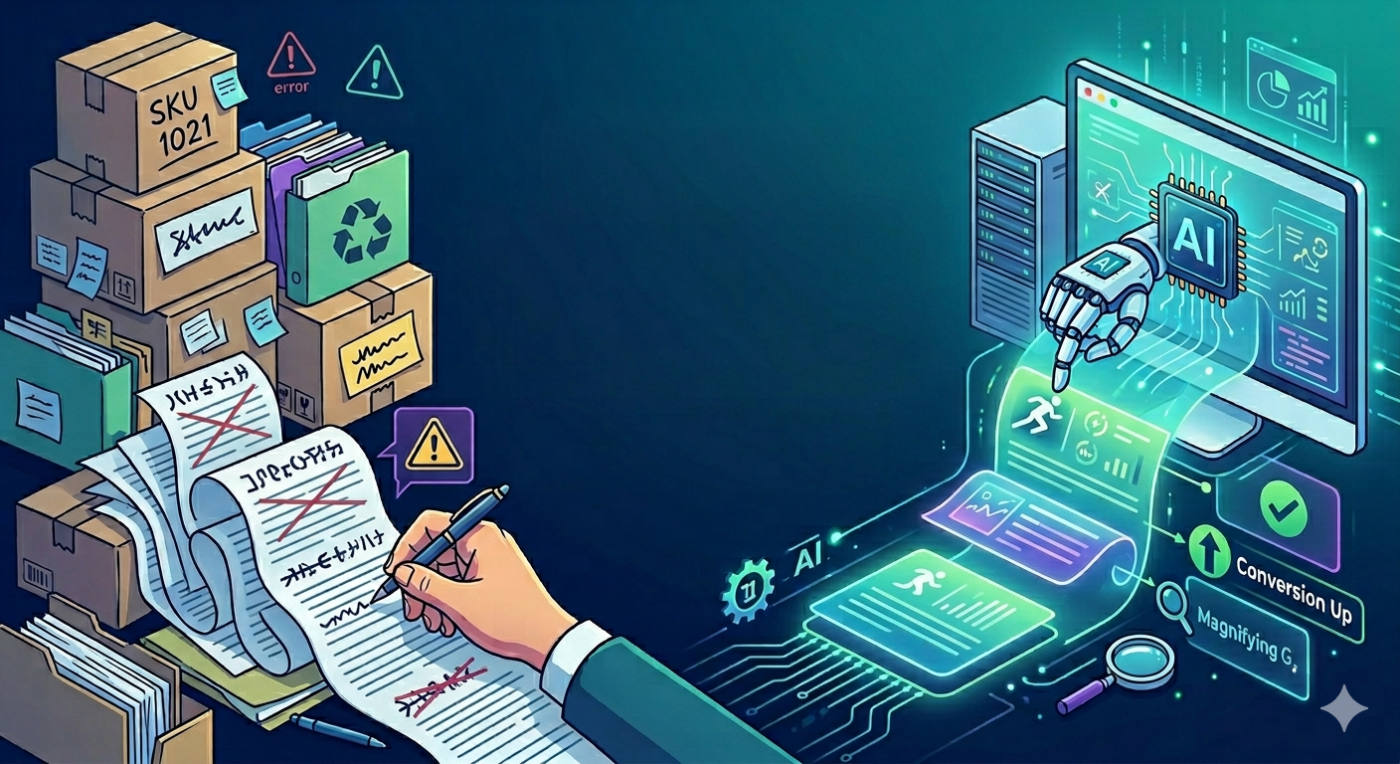
You have hundreds or thousands of products – and every single one needs a description. Writing them manually isn’t realistic, and copying text from your suppliers damages your position in Google search results. In this article, we’ll show you how to write unique product descriptions when the scale of your catalogue goes beyond what any team can handle manually – and when automation is the right answer.
What Makes a Product Description Work – The Basics
Before we get into scale, it’s worth revisiting what separates a good product description from a weak one. These principles don’t change, whether you’re writing 10 descriptions or 10,000.
Benefits over specifications. Customers don’t buy "220 g/m² fabric" – they buy "a hoodie that keeps its shape after dozens of washes." Specifications matter, but benefits sell.
Write for a specific person. A description that speaks to everyone connects with no one. If you sell tools, write for the DIY enthusiast. If you sell skincare, write for someone looking to solve a specific skin concern.
Uniqueness. Duplicate content issues can limit your visibility in Google. If 50 shops share the same supplier description, none of them will stand out in search results. A unique description isn’t a luxury – it’s a basic requirement for ranking.
Structure. A headline that tells customers what the product is. A short lead with the main benefit. Features translated into benefits. A clear CTA (buy, add to basket, check availability).
You’ll find these principles in any copywriting guide. The challenge starts when you need to apply them to hundreds or thousands of products at once.
Why Writing Descriptions Manually Doesn’t Work at Scale
Copywriting guides teach you to write one great description. You spend 15-30 minutes on research, write, refine – and you have something that converts. That works fine when you have a few dozen products.
The time problem. Manually adding just 1,000 products – including descriptions, images and attributes – takes around 160 hours. That’s around one month of full-time work for one person. And in a dropshipping model, your catalogue changes faster than anyone can keep up with.
The cost problem. A freelance copywriter typically charges £4-£10 per product description. For 2,000 products, that’s £8,000-£20,000. For most online shops, that’s simply not a sustainable budget – especially when new products arrive every quarter.
The rotation problem. With dropshipping businesses, inventory has a life of its own. Suppliers add new products, discontinue old ones, change variants. Your copywriter falls behind – and your shop ends up with a growing number of products with no descriptions, or descriptions copied directly from the supplier.
What happens next is predictable: your catalogue grows, but your descriptions don’t keep up. The larger the range, the bigger the content gap.
Three Common Description Mistakes – And How They Hurt Sales
When a shop can’t keep up with descriptions, three problems tend to appear.
Copying supplier text word for word
The fastest solution – and the worst one. If your description matches dozens of other shops, you’re creating duplicate content issues that can hurt your search rankings. Customers end up finding your competitors who took the time to write something original.
No description at all
A product without a description is a product that doesn’t rank in Google and doesn’t convert in your shop. Customers see a photo, a price and nothing else – there’s no reason to trust and buy. No description isn’t a time-saving shortcut. It’s lost revenue.
Generic descriptions that fit any product
"Premium quality product, perfect for discerning customers." Sound familiar? Descriptions like this say nothing specific, don’t differentiate the product and don’t build trust. Customers can tell when no one has paid attention.
How to Approach Descriptions at Scale – Practical Strategies
You don’t need to write every description from scratch. At scale, different approaches work better.
Category templates
Instead of writing every description individually, create a template for each category. Sports shoes have a different description structure to electronics – but all sports shoes follow the same pattern: material, intended use, technology, sizing. The template is a framework you fill in with each product’s data.
Prioritise your bestsellers
Not every product needs a description on the same day. Start with bestsellers and highest-margin products. The rest can wait – or get a description generated automatically.
Automated description generation from product data
Every product in your shop has data: a name, attributes, a category, technical specifications. AI can use that data to generate a description that’s unique, readable and contains the key information. It won’t win a literary award – but it’s better than no description or a copy from your supplier.
The role of AI – what it does well, where it needs human input
AI is effective at generating descriptions from product data – it creates unique texts, maintains structure and works in keywords naturally. But AI doesn’t know your customers as well as you do. That’s why the best results come from a hybrid approach: AI generates the base, a person reviews and refines where needed.
What This Looks Like in Practice – An Automation Workflow
Here’s what a practical, scalable description process can look like:
Step 1: Import product data from suppliers. Your shop pulls data from your suppliers – product names, attributes, categories, technical specifications. If you work with multiple distributors, that can mean tens of thousands of lines in different formats.
Step 2: Normalise the data. Every supplier delivers data in a different format – XML, CSV, API. An integration layer normalises the data, standardises category names, attributes and formats so they’re ready to work with.
Step 3: Generate descriptions with AI. Based on the normalised data, AI creates unique descriptions. Each one is different because it’s built from the specific attributes of that product – not one template copied 1,000 times.
Step 4: Review and edit. AI doesn’t publish on its own. Descriptions go through a human review – checking quality, adjusting tone and verifying accuracy. At scale, you don’t need to read every single description. Spot checks and clear global guidelines are enough.
Step 5: Publish to your shop. Finished descriptions go live automatically, alongside the rest of your product data.
Megamo handles this workflow from start to finish – importing data from more than 273 suppliers, normalising it, generating AI descriptions – all through one central integration layer. Everything in one place, without manually connecting data from different sources.
When Automation Makes Sense – And When It Doesn’t
Automation isn’t the right answer for every situation. Here’s how to know when it makes sense for you.
It makes sense when:
- You have more than 200-500 products – beyond that threshold, manual descriptions become too expensive and time-consuming
- You work with multiple suppliers – the more distributors you have, the more products need describing and the more complex the data formats
- Your range rotates regularly – new products arrive faster than your team can write descriptions for them
It doesn’t make sense when:
- You have a small number of premium products where each one needs individual storytelling and an emotional, crafted description
- You sell products that require specialist technical knowledge that AI simply doesn’t have in the input data
A hybrid approach works best in most cases: AI for the bulk of your catalogue, hand-written descriptions for flagship products. That way you save time where you can and invest attention where it delivers the most return.
Summary
The principles of a good product description don’t change – the scale does. Manual writing works for a few dozen products, but at hundreds or thousands of SKUs it becomes a bottleneck. Copying supplier text is a fast track to poor search visibility.
So what’s the solution? AI-generated descriptions with human quality control. Import product data from your suppliers, normalise it, generate unique descriptions and publish – the whole process can run without manual rewriting for every single item.
If your shop works with multiple suppliers and you have hundreds of products waiting for descriptions, try Megamo’s AI product description generator. See how it works with your own catalogue.