


You’ve got a few hundred products from a supplier and you’re thinking: "I’ll add them by hand for now and set up an integration once the shop grows". Is supplier integration worth it for a catalogue that size? It’s a fair question, but it usually gets unhelpful answers – "you can’t run dropshipping without integration" or "it’s worth it once you have lots of products". Nobody says how many counts as "lots". So instead of a slogan, here’s the maths: what it costs to add products by hand, what it costs to keep their prices and stock up to date, how many hours an integration has to save to pay for itself – and when manual work is still enough.
Instead of "integration always pays off" – the numbers
The decision to integrate a shop with a supplier is usually made on gut feeling. At the start there aren’t many products, there seems to be enough time, and a subscription is a cost you see straight away. The cost of manual work is less visible, because no invoice ever arrives for it – so it’s easy to assume it’s free.
It isn’t. It simply has two parts worth calculating separately. The first is the one-off job of adding products to your shop. The second is the cost people think about least at the start: keeping the catalogue in line with what’s happening at the supplier. Both can be converted into hours, and hours into pounds.
Calculation 1: what it costs to add products by hand
The starting point: adding 1,000 products manually takes around 160 hours. That’s just under 10 minutes per product.
For smaller catalogues, it looks like this:
| Number of products | Time | Cost at £15/h |
|---|---|---|
| 100 | approx. 16 h | approx. £240 |
| 300 | approx. 48 h | approx. £720 |
| 1,000 | approx. 160 h | approx. £2,400 |
£15 an hour is the full employer cost of an e-commerce specialist in the UK in 2026 – salary plus employer contributions. It’s the same rate we used when calculating the cost of manual order entry. If you run the shop on your own, it isn’t an invoice, it’s your time – but it costs the same, because you can’t spend those hours on anything else.
1,000 products is more than four weeks of full-time work. Just entering data, before the shop sells a single thing.
One caveat: this is an average. If the supplier’s file is missing a description, someone has to write it, and the time per product goes up.
Calculation 2: the cost that comes back every month
You add products once. After that, the supplier’s catalogue takes on a life of its own: prices change, products sell out, then come back in stock. Every change you don’t carry over to your shop ends in one of two ways. Either you sell at the old price – and if the supplier has raised it, your margin shrinks. Or you sell a product that’s no longer there – and instead of an order you get a cancellation, a refund and an unhappy customer.
How much this costs depends on your supplier and your range, so rather than guessing, use a formula:
number of changes per month × time for one update = hours per month
An example – the figures are purely an assumption to show how it works: if 20 products in your catalogue change price or stock in a week, and one update (finding the product, changing it, saving) takes 2 minutes, that adds up to around 80 updates and nearly 3 hours of work a month. On top of that, there’s time the formula doesn’t show: before you can update anything, you need to know what has changed – which means regularly comparing your shop with the supplier.
This cost comes back every month and grows with your catalogue. And if you work with several suppliers – which is typical among our clients – you multiply it by the number of suppliers. Each supplier shares data in its own way (an XML file, CSV or API), with a different structure and a different pace of change, so you handle each one separately.
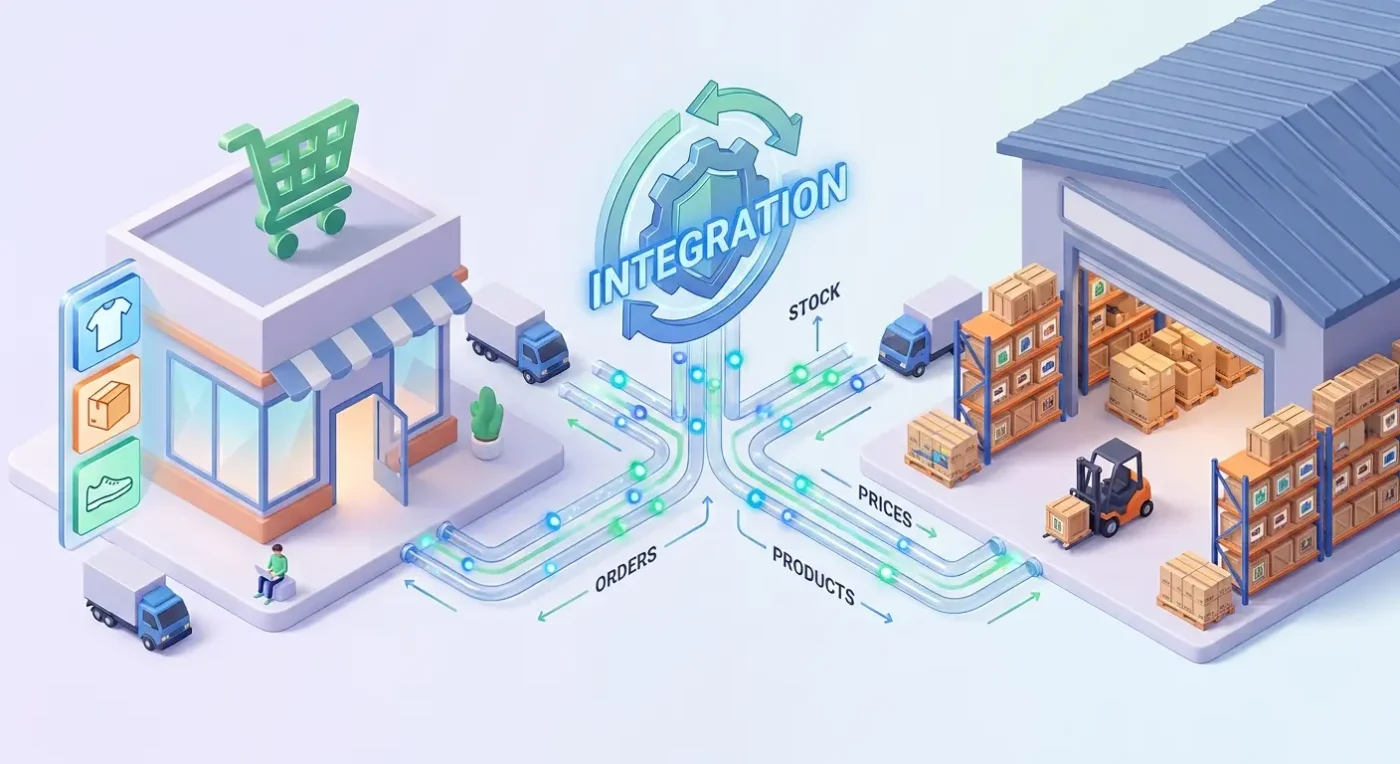
This is exactly the part of the work that integration largely takes over. In our integrator, supplier data is fetched automatically every 5-15 minutes, and stock levels in your shop update without you lifting a finger, as long as the supplier provides them. If you switch on automatic price updates, the selling price recalculates itself according to the markup you’ve set – a percentage or a fixed amount – and your chosen rounding, for example to .99. We explain how to set this up in our article on dropshipping pricing rules, and what decides how fresh your stock data is in our piece on supplier inventory sync frequency.
How many hours does integration need to save to pay for itself
This is where the second formula comes in – and it’s the one that answers the question in the title:
monthly integration price ÷ cost of an hour of your work = hours per month the integration has to save to pay for itself
An example (prices as of October 2026): our cheapest supplier integration package costs €15.90 a month (VAT may apply) and covers one supplier and up to 3,000 products. That’s roughly £13.50 at the early October 2026 exchange rate. At £15 an hour, it works out at less than an hour a month.
Put that next to both calculations:
- Adding just 100 products by hand (approx. £240) is the equivalent of almost a year and a half of the cheapest package.
- If keeping prices and stock up to date takes you more than an hour a month, integration pays off – even before you count the time saved on adding products.
Prices change, and a bigger catalogue means a bigger package, so the formula matters more than any specific figure. You’ll find current prices in our pricing – plug them into the formula and your result will always be up to date.
When manual work is still enough
To be fair: some shops don’t need integration yet. If you have a few dozen products from one supplier, and their prices and availability rarely change, manual work will probably take you less than that hour a month, and there’s no reason to change anything.
With a threshold that low, though, it’s a small group. The sign that manual work is no longer enough usually shows up on its own: you start falling behind with changes, the first cancellations appear because an item is out of stock, or you sell at a price the supplier changed long ago.
That’s why we don’t give one "magic number" of products above which integration pays off. The line isn’t drawn by the size of your catalogue, but by how often the supplier’s data changes compared with how much time you can spend on it. So even a shop with 150 products can benefit from integration – if its supplier changes prices and stock every week.
What integration won’t fix
Integration brings into your shop whatever the supplier makes available. If something isn’t in the supplier’s data, integration can’t create it.
Some product files have no stock levels at all – there’s a name, a price and a photo, but nothing about whether the item is available. In that case automatic availability updates are impossible, and that part of the work stays with you. Some files have no product descriptions, or only fragments – the import will bring over the name and price, but the description has to be produced, for example with AI-generated product descriptions.
So before you work out whether it pays off, check the supplier’s file. We’ve described what to look for and what to watch out for in our article on dropshipping supplier data quality.
Do the maths on your own catalogue
So, is supplier integration worth it for your shop? You only need two numbers. The first: how many hours a month you spend keeping prices and stock up to date across all the suppliers you work with. The second: how many hours the integration costs you – its monthly price (the combined price if you have several suppliers) divided by the cost of an hour of work. If someone does this for you, use their hourly cost; if you do it yourself, use £15, as in the calculations above. If the first number is bigger, integration already pays off – and the time saved on adding products is an extra gain.
If, on top of products, you also re-key orders into your supplier’s system by hand, that’s only half the picture – we worked out the other half in our article on the cost of manual order entry.
Got your result? Compare it with our supplier integration pricing and check whether your supplier is on the list of ready-made integrations.