


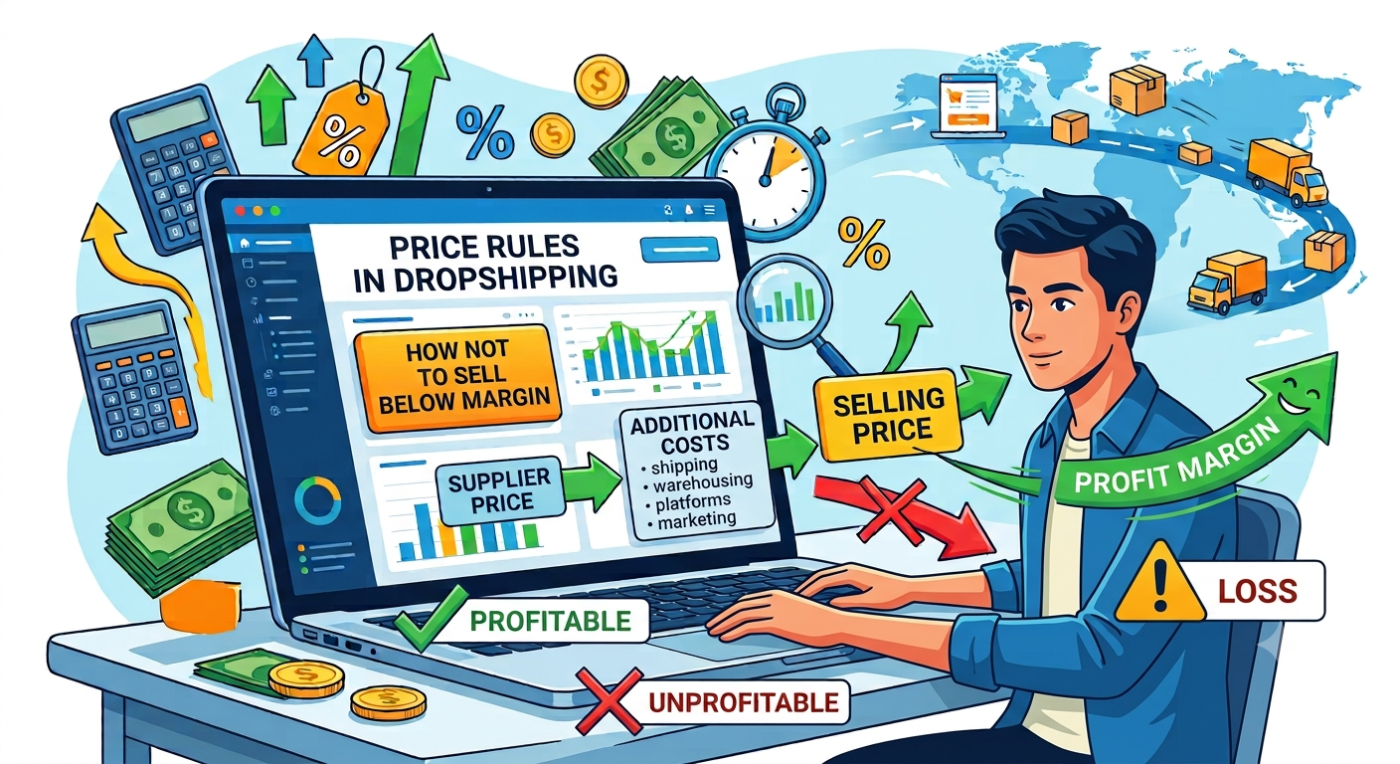
In dropshipping, your supplier sets the cost price and you set the selling price. The trouble starts when the supplier raises prices and your shop doesn’t notice. We’ll show you how pricing rules automatically protect your margin – without recalculating every product by hand.
The silent price rise, or how your margin disappears
Picture a simple scenario. You sell a product for £50 and buy it from your supplier for £35. The margin looks healthy. A week later the supplier raises the cost to £42, but your shop still sells at £50. You earn less and less – and you don’t even know it.
With one product it’s a trifle you’ll spot with the naked eye. Across a few thousand products it becomes a real hole in your results – often visible only at month’s end, when you wonder why sales grew but profit didn’t.
The good news: you can set this up so the selling price reacts to the supplier’s change on its own. That’s what pricing rules are for.
Why manual price monitoring doesn’t work
The first instinct is "I’ll watch the prices myself". In practice that’s impossible – and not because of carelessness.
Scale does its thing. Adding just 1,000 products by hand takes around 160 hours – roughly a month of full-time work. And prices need checking not once, but every day – across thousands of items, nobody can keep up manually.
On top of that, supplier prices change independently of you, usually without warning. A spreadsheet will always be a step behind the supplier. And the margin formula itself (selling price minus cost) is useless if you don’t know the cost has just changed.
That’s why you don’t guard margin with a calculator. You guard it with a mechanism that works automatically.
What pricing rules are and how they protect your margin
A pricing rule is an automatic converter. It takes the current cost from your supplier and applies your markup before the price reaches your shop. In the Megamo integrator this is made up of:
- A percentage or fixed markup – for example adding 30% or a set amount to the cost price.
- A pricing policy with threshold-based markup – a different markup depending on the product’s price (cheaper items can carry a higher percentage, pricier ones lower).
- Final-price rounding – several models to choose from: x.00, x.49, x.50, x.99 or no rounding.
What matters most is when the rule recalculates. If you have automatic price updates switched on, the cost refreshes from the supplier feed and the markup applies to that fresh cost. When the supplier raises the price, a percentage markup lifts the selling price too – your percentage margin stays intact, with no manual recalculation. That’s the difference between a "margin formula" and a mechanism that actually keeps that margin.
Alerts and control – automation doesn’t take decisions away from you
Automation guards the markup in the background, but the pricing strategy stays with you. The point is that only the exceptions should need your attention.
The integrator provides a dashboard with operational alerts – a signal when something needs your decision. You set the pricing policy once, and then step in where a human decision is needed. Automation takes over the repetitive recalculations; you stay with the strategy.
Different markups for different products
One percentage across the whole shop rarely makes sense. That’s why the markup in your pricing policy can be varied – by threshold depending on the product’s price, and separately for different product categories.
Cheaper items often bear a higher percentage markup, while with pricier ones it’s unfortunately easier to end up with too high a final price, so the markup tends to be lower. Likewise, in highly price-competitive categories the markup has to be lower – shoppers compare prices easily, unlike with niche products. This lets you match your pricing to your assortment, instead of pasting the same percentage onto everything.
Which markup pays off where is a separate topic – we wrote about it around high-margin products in dropshipping.
Who this is for
Pricing rules give the most where manual control is impossible. The more products and the more suppliers you have, the greater the risk that a silent price rise at one supplier slips through unnoticed.
If you run a small shop with a single, price-stable supplier, the problem is smaller. But once you have hundreds or thousands of SKUs across several suppliers, automatic margin control stops being a convenience and becomes a necessity.
Pricing rules are, after all, one part of a bigger whole – automatic supplier integration, where prices, stock and orders work together. We covered that in more detail in the piece on online store automation.
Summary
In dropshipping, margin isn’t protected by a formula or a spreadsheet. It’s protected by a markup applied to the fresh cost from your supplier – with automatic price updates on, the selling price recalculates itself and your percentage margin holds. A pricing policy with threshold markup and price rounding then tailors your pricing to your assortment. That turns price monitoring from a daily grind into a setting that runs itself.
Want to see how it works in practice? Check out our integrations with suppliers and how the integrator keeps prices and margin under control.