


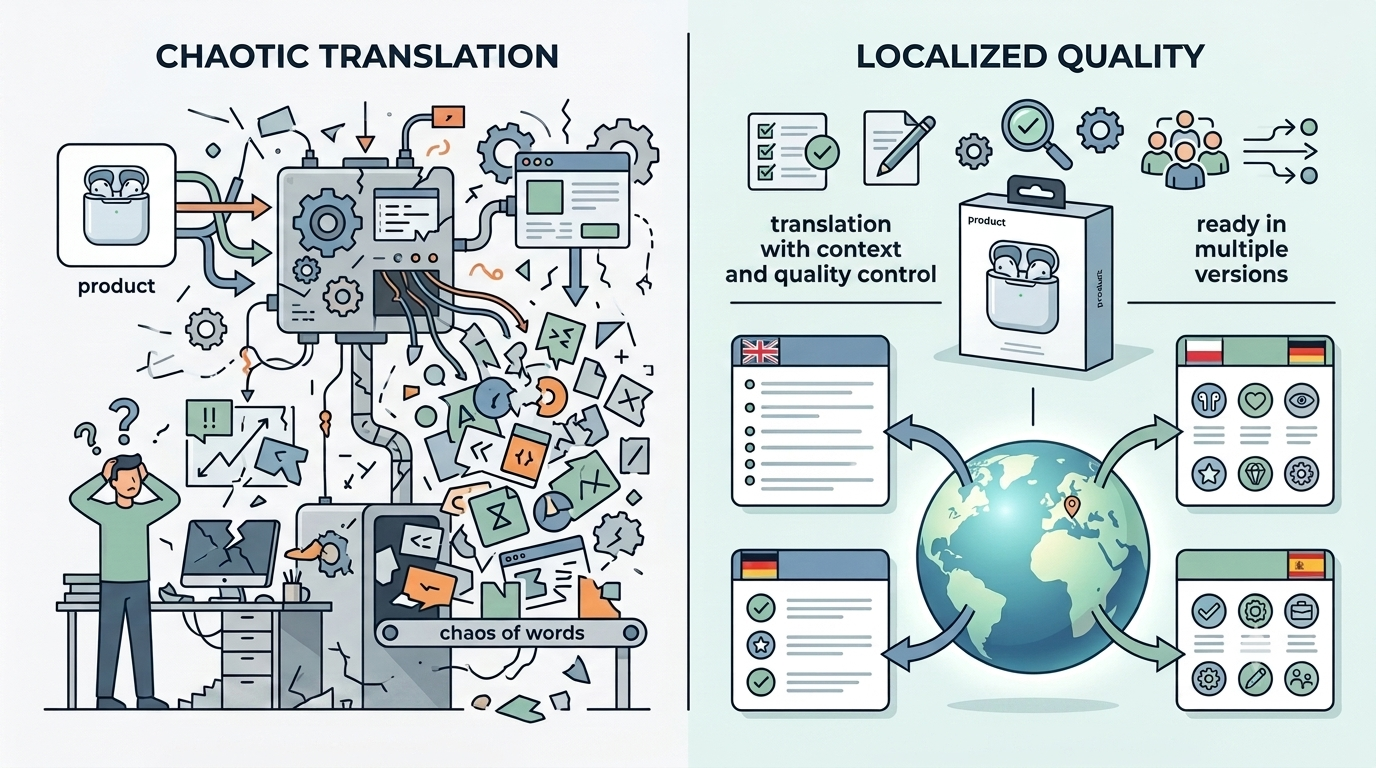
Tempted to run your product descriptions through Google Translate and be done with it? For a single product or an occasional translation, it works. For a whole catalog from a supplier – not so much. Below we show where a free translator is fine, where it starts to hurt, and what the third way between "cheap and poor" and "expensive and slow" looks like.
When a free translator is enough – and when it starts to hurt
There’s no point pretending free translators are useless. When you want to quickly understand a single description, check one product or translate a short note – Google Translate or DeepL will do the job. For that kind of task they’re good, fast tools, and nobody argues otherwise.
The problem shows up at scale. An online store fed by a supplier isn’t one sentence – it’s hundreds or thousands of products: names, descriptions, short descriptions, specifications, SEO fields. On top of that, the catalog is alive – the supplier adds new items, changes descriptions, updates parameters. And if you sell on several markets, you need each of those products in several languages at once.
That’s the crux: a free translator handles an occasional, small translation, but fails on a living product catalog. Let’s break that down into three concrete reasons.
Three things a free translator won’t do for a product catalog
When people say "AI translation needs oversight", they usually stop there. So let’s be specific about what a free translator lacks when it comes to a store catalog.
-
It doesn’t know the context. A translator works word by word. It doesn’t know this is a product description in your industry, that it reaches a customer on a specific market and is meant to encourage a purchase. The result is grammatically correct but artificial, generic sentences that don’t read like a store’s copy – they read like a machine translation.
-
It has no quality control. With one product you’ll spot the error right away. With a thousand it’s all or nothing – either you blindly trust the machine, or you read everything by hand. A free translator won’t give you a layer where you can see which translations are weak and fix them before they hit the store.
-
It doesn’t track changes. The supplier changes a product description, adds new items to the feed – and the translator has no idea. You have to remember yourself what changed and what needs re-translating. With a rotating catalog that’s never-ending work, and it’s easy for the supplier feed and what the customer sees to drift apart.
These aren’t flaws of "artificial intelligence" as such. They’re the limits of a tool built to translate text, not to run a store catalog fed by a supplier.
A translation agency – why it isn’t always the answer for a rotating catalog either
The natural reflex is to go the other way: if the machine fails, hand translation over to a human. A professional translation agency gives you quality, linguistic feel and a fit to the market. For premium copy, campaigns or key pages – that makes sense.
The trouble is that a product catalog fed by a supplier follows a different logic than a marketing brochure. With thousands of rotating SKUs, every new import and every change at the supplier is another job for the agency. The pace of human work can’t keep up with the pace of changes in the feed.
In practice it ends one of two ways: either a bottleneck and delays (products waiting to be translated instead of selling), or you do the same work twice – you import the products once, and then, separately, in another tool, you organize their translation and move the result over by hand. Quality goes up, but scale and speed go down.
The third way: context-aware AI with quality control, built into synchronization
Between a free translator and an agency there’s a path that takes the strengths of both: the quality and control of human translation, and the speed and scale of automation. That’s how our mTranslation module works.
Translation with context, not word by word. mTranslation is not a plain translator – on top of machine translation it adds context: the industry, the market and the store’s communication style. So the description isn’t made up "out of thin air" and isn’t a raw rendering – it’s based on the product’s data and knowledge of the category.
A human in the loop. Every translation gets a quality score. In the review panel you see the original next to the translation (with formatting preserved), and you can accept, edit or reject it. There are bulk actions when you want to approve a whole collection at once, and a "Translate now" option for urgent products that can’t wait in the queue. This is deliberate: AI takes over the repetitive work and leaves the decision to a human.
Built into synchronization. Translation happens in the background during the supplier feed synchronization – not as a separate project and not in a separate tool. One source feeds many language versions of the store at once, so entering another market doesn’t mean multiplying manual work. If you want to see exactly what you gain from automating translations, we’ve put it together in a separate article.
Reacting to changes. When the supplier changes a product description, the module detects it and flags the item for re-approval. You don’t have to remember yourself what changed in the feed.
What about SEO and duplicate content?
The most common fear goes: "if I translate automatically, Google will treat it as thin, duplicated content". That’s a fair concern – search engines reward unique descriptions, and generic, copied text is sometimes treated as lower-quality content.
That’s exactly why context matters, and not only for the reader. A translation based on a specific product’s data and its category produces descriptions closer to unique than a raw, repetitive word-by-word rendering – a mechanism that reduces the risk at the source. mTranslation also translates not just the text visible on the page but the SEO fields too: the meta title and meta description for each language version.
On top of that comes a layer a free translator doesn’t have: before a description reaches the store, it can pass through a human – for approval or editing. It’s not "set it and forget it", but a process with quality control.
How it looks in practice – three typical scenarios
The easiest way to show this is with real translation directions, from the simplest to the most scalable:
- Polish supplier, selling in Italy. A Polish wholesaler has a feed only in Polish, while the store sells to Italian customers. Products reach the store translated from Polish into Italian.
- UK supplier, selling in Spain. An English supplier feed, a store serving Spanish-speaking customers – translation from English into Spanish.
- Polish supplier, Nordic expansion. One Polish feed translated at once into four languages: Swedish, Danish, Norwegian and Finnish. The more markets, the bigger the saving – the same source feeds every version.
From one language to four at once, the principle is the same: one product import, a catalog ready to sell in many languages at once, without duplicating manual work for each market.
Summary
A free translator is fine for an occasional, small translation or a quick check. With a product catalog fed by a supplier it starts to hurt, because it doesn’t know the context, gives you no quality control and doesn’t track changes at the supplier. An agency solves quality but loses speed and scale. The third way is context-aware AI with quality control, built into feed synchronization – translation that understands the product, passes through a human and keeps up with a living catalog.
Want to see how it works on your own products? Check out the mTranslation module and grab 50 free trial credits: product translation for suppliers (XML/CSV).